Cyling Belgium & Northern France (Day 6)
Day trip to Vimy Ridge and the Canadian Memorial
Shelley and Gareth took a rest day to explore a nearby château, while Andrea and I pointed our bikes towards Vimy Ridge.
Not the best of starts: Andrea got a puncture within a mile, but we were soon back on track after a speedy tube change, Gareth can certainly change a tyre better than I can.
The ride itself involved the most climbing so far, and perhaps the windiest especially across the fields of corn, but the reward was immense.
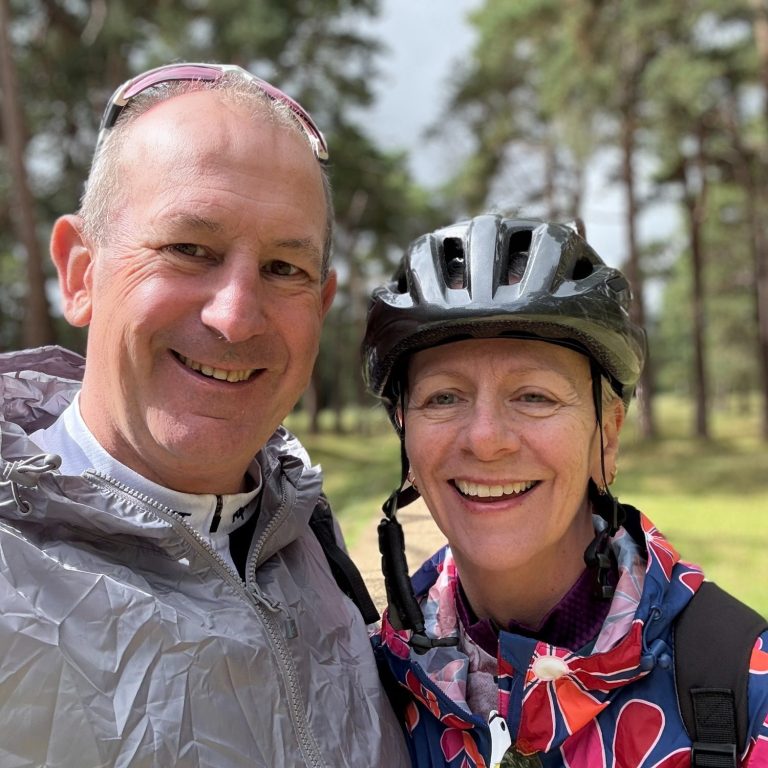
We arrived to dappled sunlight through the trees, a breathtaking approach. It was free to enter the grounds, though guided tunnel tours cost extra. Even without them, standing in the grounds and overlooking the ridge was unforgettable.
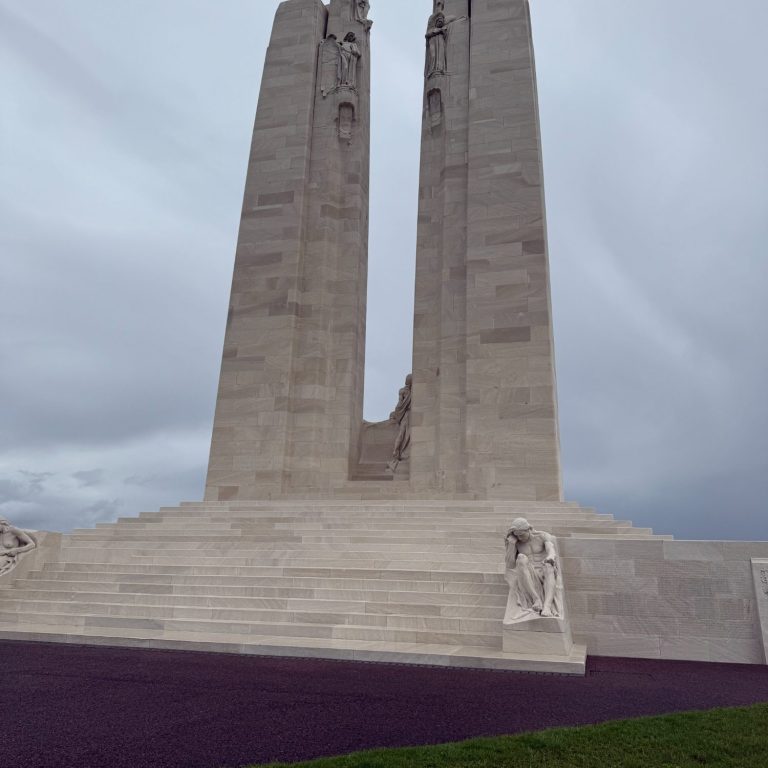
The Vimy Ridge Canadian Memorial is one of the most moving sites of the Great War. Carved in brilliant white stone, two towering pylons soar skyward, representing France and Canada. From the crest, the views stretch for miles, a reminder why this high ground was so bitterly contested.
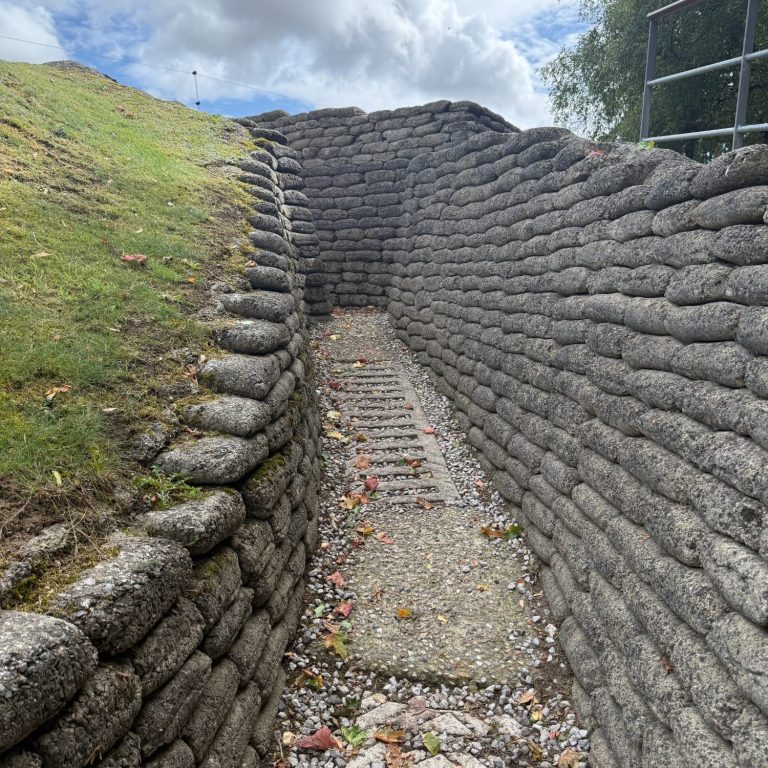
The preserved trenches show just how close Canadians and Germans were, in some places barely 25 metres apart. Fields around the memorial remain fenced off due to unexploded shells, a haunting sign that the land still hasn’t fully healed.
The Battle of Vimy Ridge began on Easter morning 1917. Amid sleet, mud and shellfire, the
soldiers of the Canadian Corps fought their way up the ridge to take the high ground
overlooking the Douai plain.
This stunning victory followed years of failed attempts to retake the ridge, and months of planning and preparation for the operation. The ridge had fallen into German hands during the
initial advances of 1914. Since then, around 150,000 French and British soldiers had fallen trying to retake it. The Germans had been fortifying their positions on the ridge for years with deep bunkers, overlapping fields of machine gun fire and layers of barbed wire. When the Canadians attacked, they directly faced around 8,000 entrenched German defenders, not counting another 2,500 in reserve, and many more to the rear.
A preliminary bombardment began on March 20 and lasted for thirteen days. In the meantime, Andrew McNaughton and his counter battery staff were hard at work finding and silencing the German guns. The Royal Flying Corps provided aerial reconnaissance, returning with
photographs of enemy batteries. The objectives set for the four divisions were four lines, the Red, Black, Blue and Brown Lines.
The battle began at 5:30am on April 9, with the first wave of around 15,000 men advancing
under the creeping barrage of almost 1000 heavy guns. Most objectives were taken on schedule, and by afternoon most of the ridge was captured, with the notable exception of The Pimple, a high point at the North end of the ridge, where defenders held out until April 12.
By April 12, the Canadians had taken all of their objectives, as well as 4,000 prisoners. The Canadians held Vimy Ridge. This victory came at a high cost as 3,598 Canadians lost their lives, and 7,000 were wounded during the four-day battle. April 9, 1917 is still the bloodiest day in Canadian military history.
On the way back the rain caught us, but a stop at a roadside hut selling fresh baguettes and pastries was a welcome surprise. The rain kindly stopped as we neared our accomodation so we took teh opportunity to eat our on the green. The ones we bought for Shelley & Gareth survived the ride back.
Later that evening we tested the villa spa properly: a swim-sized jacuzzi, Only Fools & Horses on TV, takeaway food (after a comically slow delivery), and plenty of laughter. Bliss.
Day One | Day Two | Day Three | Day Four | Day Five | Day Six | Day Seven | Day Eight | Reflection